The EU Forced Labour Regulation: From Theory to Implementation
Sep 1, 2026

On 30 June 2026, the same week the OECD celebrated its 50th anniversary, the European Commission launched the Forced Labour Single Portal.
The portal forms the foundation for the implementation of the EU Forced Labour Regulation (EUFLR), which will start applying on 14 December 2027.
The launch comes at a time when there is a lot of movement on forced labor regulations, from the USA’s Section 301 investigations, Canada’s proposed Bill C-35 on forced labor, USA CBP updated Forced Labor Enforcement Operational Guidance for Importers and Brazil’s next steps on Bill 2799/2025, prohibiting the use of forced and child labor.
What is the EU Forced Labour Regulation?
The EUFLR aims to make sure that as of 14 December 2027, no product made with forced labor is sold in or exported from the EU market.
The EU aligns with the ILO when defining forced labor “all work or service which is exacted from any person under the threat of a penalty and for which the person has not offered himself or herself voluntarily”. It classifies three main types:
Privately imposed forced labor
State-imposed forced labor (SIFL)
Forced child labor
The forced labor ban covers:
All products, whether imported into or produced in the EU, excluding services
All geographic areas, while recognizing that some areas may present a higher risk of forced labor
All companies placing products on the EU market or exporting them from the EU, including manufacturers, importers, distributors, retailers and online sellers
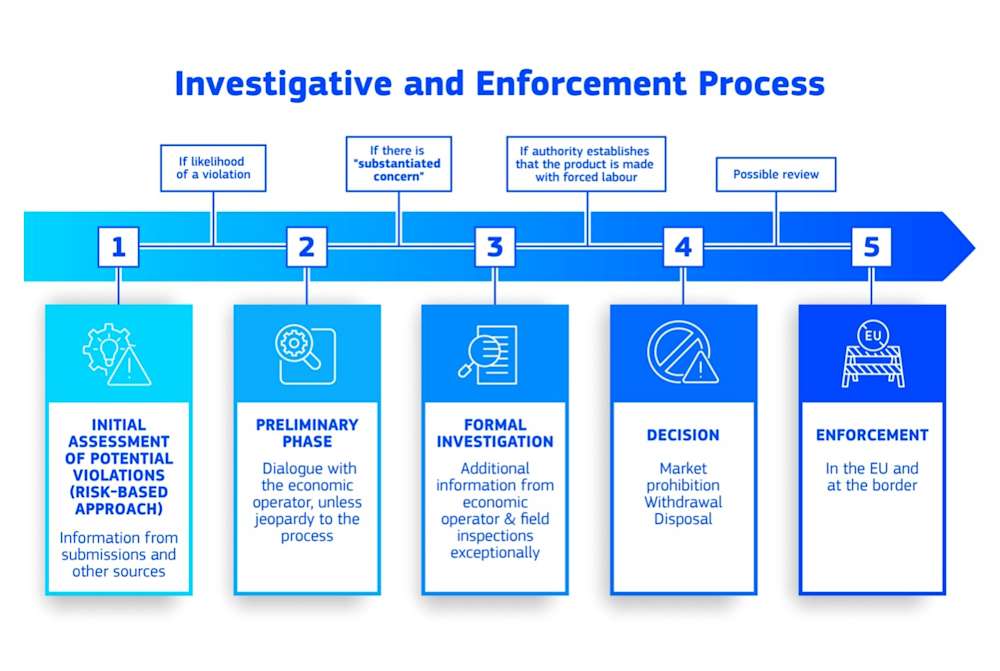
Implementation is based on an Investigative and Enforcement process, starting with a risk-based assessment of potential violations. Potential violations can be brought to the Commission by individuals and organizations via the Single Information Submission Point, which will open on the application date.
The ban on the import / export of products made with forced labor is absolute and not dependent on whether an investigation is launched.
Cases within EU borders will be investigated by the relevant competent authority, and cases outside of the EU will be handled by the Commission. They will apply pre-defined criteria to identify products and prioritize cases for investigation.
What is the Forced Labour Single Portal?
The portal is a pivotal tool for EU Forced Labour Regulation implementation and enforcement, intended to be used by businesses, competent authorities and civil society. In short, it provides:
A database of forced labor risks. This database is still in development and will provide indicative information on “products and geographical areas where forced labor risks have been documented in credible, publicly available sources.”
An access point to report forced labor, to be opened on 14 December 2027
A list of useful resources, such as Anti Forced Labor preparedness checklist (separate one for SMEs), free online tools for supply chain traceability, ILO and OECD resources
EU Forced Labour Regulation Guidelines
The portal also provides access to webinars and training which are planned to start in September.
Forced Labor Due Diligence
The EU Forced Labour Regulation imposes an obligation of result and builds on international instruments that prohibit forced labor, such as ILO Conventions. It does not provide specific due diligence obligations on companies but recognizes due diligence as a useful tool to address forced labor in supply chains.
The EU Forced Labour Regulation Guidelines clarify:
Products in scope cover manufactured products, agricultural products as well as products that are extracted, such as minerals and other raw materials.
The EUFLR applies to products that are placed or made available after 14 December 2027, even if the products or their components were produced or imported into the EU before that date.
Online or distant sales are in scope if the sale targets end-users in the EU
Definition and types of forced labor as well as common indicators of forced labor
The investigative process, including examples of information and traceability to be provided by companies
Enforcement and penalties
Non-binding due diligence guidance for companies, aligned with the OECD six-step due diligence framework. Proportionality at its base, companies should start with integrating forced labor due diligence in their policies and risk management systems, with the understanding that risk identification is only one step, always to be followed by risk mitigation.
The entire toolset of document review, supplier self-assessments, on-site inspections and audits, worker interviews and stakeholder engagement should be used to conduct an in-depth assessment of the most significant forced labor risks.
How can companies prepare for the EU Forced Labour Regulation?
The EUFLR works based on the principle of proportionality, where large companies may need more formalized and extensive due diligence systems to manage forced labor risks than smaller companies with a limited range of products, supply chains and stakeholders.
Companies are encouraged to seek collaboration with their peers.
Where to start?
Review existing policies to ensure forced labor risk is adequately covered.
Update your risk management system to include forced labor risk identification and mitigation.
Run a first broad scoping exercise of your operations and business relationships to identify general areas where forced labor risks are most likely to occur and be most significant.
Assign internal roles & responsibilities for implementation and monitoring.
Create a decision tree or matrix to support prioritization of risk mitigation activities.
Provide training to relevant departments.
Review and update supplier contracts and code of conduct where needed.
Communicate with suppliers and other relevant business partners.
How can QIMA help with the EUFLR?
Share this on