
Acceptable Quality Limit (AQL)
Our AQL sampling simulator helps you calculate the appropriate sample size and acceptance number for your inspection. Try the tool now and optimize your sampling process.
Our AQL sampling simulator helps you calculate the appropriate sample size and acceptance number for your inspection. Try the tool now and optimize your sampling process.
AQL is a risk management tool, but only if the numbers are calibrated to your actual risk tolerance. Set it too lenient and defective batches pass inspection. Set it too strict and good shipments get rejected, damaging supplier relationships and delaying production. Most buyers copy an AQL setting they've seen elsewhere without understanding what it means for their specific product, defect profile, and batch size.
Even a correctly set AQL delivers unreliable results if the inspection isn't independent. When sampling is performed by the factory's own quality team, the incentive is to pass, not to find defects. A batch that passes a supplier-run AQL check and a batch that passes an independent third-party inspection to the same AQL are not the same outcome.
The Acceptance Quality Limit (AQL) is used in product inspections to determine the maximum acceptable number of defective items in a sample batch. If the number of defective items is higher than the maximum acceptable limit, the batch is rejected. AQL is typically set differently for minor, major, and critical defects. Since critical defects are unacceptable, AQL for critical defects is commonly 0.
In sampling inspections, QIMA inspectors follow the ISO 2859 standard, which forms the basis for the Acceptable Quality Limit (AQL) methodology. The standard provides tables to determine sample sizes and defect thresholds, ensuring precise and reliable quality assessments.
Inspecting a representative sample instead of every item in a batch provides significant advantages for quality control programs:
Reduces inspection time and cost without compromising quality standards.
Balances the risk of accepting defective products against the effort of inspection.
Supports different AQL levels for different defect types and product categories.
Provides clear, objective criteria for accepting or rejecting a production batch.
QIMA inspectors are trained to ISO 2859 AQL sampling standards and operate in 100+ countries. Inspector onsite within 48 hours.
Get a quoteEnter your shipment quantity, inspection level, and AQL values into the calculator below. The tool calculates your required sample size and accept/reject points based on ANSI/ASQ Z1.4 (ISO 2859) sampling tables.
For example, to inspect 4,000 face masks at General Inspection Level II with an AQL of 2.5, enter:
Quantity: 4,000
Inspection level: General Inspection II
AQL: 2.5
QIMA inspectors use AQL sampling at your factory. Onsite within 48 hours.
Table A maps your shipment size (lot size) and inspection level to an AQL code letter. Find your lot size in the left column, cross-reference with your chosen inspection level, and note the code letter. Take that letter to Table B to find your required sample size and accept/reject thresholds.
Example: A shipment of 4,000 units inspected at General Inspection Level II gives code letter L.
Note: Tables below are based on ANSI/ASQ Standard Z1.4 – 2008.
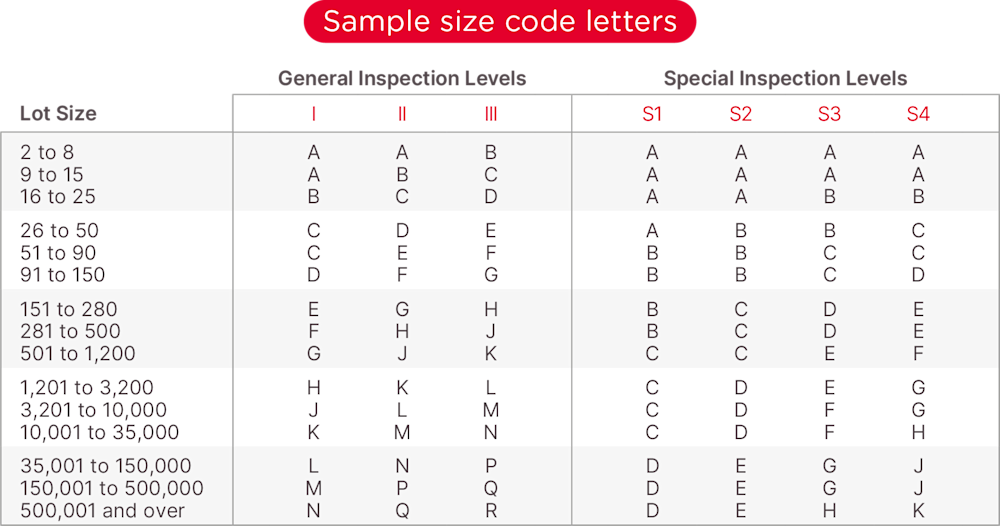
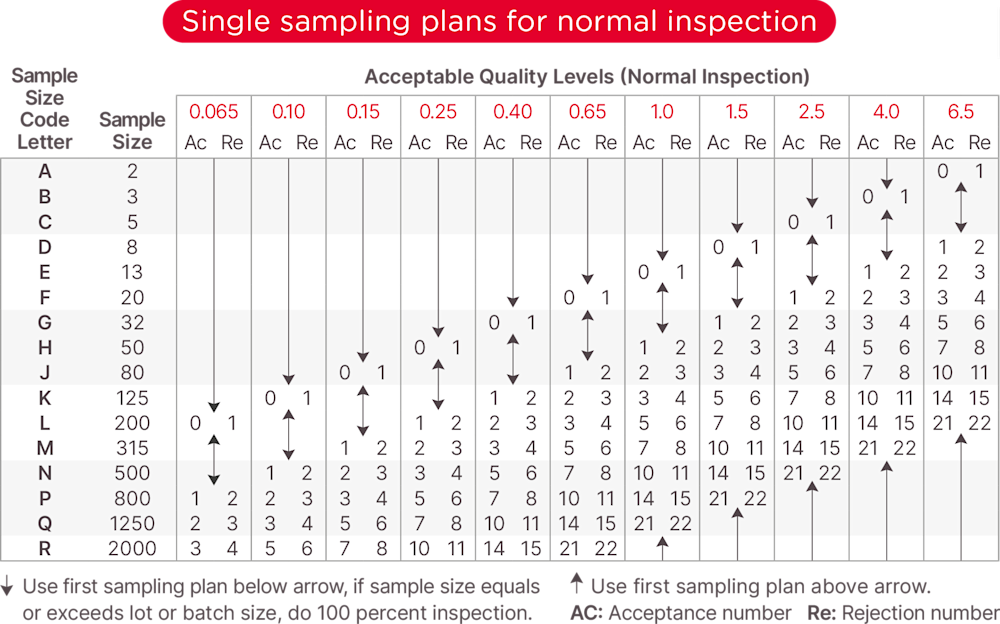
Table B maps your code letter to a required sample size and defect thresholds for each AQL level. Find your code letter in the left column, then locate your AQL value across the top row. The intersection tells you how many units to inspect and how many defects are acceptable before the batch is rejected.
Example: Code letter L at AQL 2.5 requires a sample of 200 units. If 10 or fewer units fail, the batch passes. If 11 or more fail, the batch is rejected.
Independent inspectors, employed by QIMA: QIMA inspectors have one objective: give you an accurate picture of batch quality. With no relationship to the factory and no incentive to pass shipments, their findings reflect actual production quality.
ISO 2859-compliant AQL sampling in 100+ countries: QIMA inspectors follow ISO 2859 sampling standards across all inspections, using the same tables and defect thresholds your quality program is built around. Coverage spans Asia, Europe, the Americas, and Africa.
Onsite within 48 hours. Same-day digital report: Book through myQIMA and receive inspector confirmation within 48 hours. Your AQL inspection report is delivered the same day, with defect photos, pass/fail against your specified AQL, and a clear accept/reject recommendation.
Your AQL settings applied consistently across every supplier: Define your AQL parameters once in myQIMA and apply them across your entire supplier base. The same standards apply whether you're inspecting in Vietnam, Bangladesh, or Mexico.
Ranked #1 for customer satisfaction: Independent NPS measurement ranks QIMA #1 in the Testing, Inspection and Certification industry. Trusted by 30,000+ brands across 100+ countries.
Clients worldwide
Countries covered
Field and lab experts
Net Promoter Score
QIMA inspectors follow ISO 2859 AQL sampling standards in 100+ countries, delivering independent inspection reports accepted by major retailers, brands, and importers worldwide.
The right AQL depends on your product category and defect risk tolerance. AQL 2.5 is the most common standard for general consumer goods. AQL 1.0 is used for higher-risk categories. AQL 4.0 is used where minor cosmetic defects are acceptable. If you're unsure, QIMA's team can advise on the right setting before your inspection.
Critical defects are safety or compliance failures — AQL for critical defects is typically 0. Major defects affect product function or appearance significantly and would likely cause a return. Minor defects are small cosmetic issues that don't affect function. AQL levels are set separately for each defect type.
Sample size is determined by your shipment quantity and inspection level using ISO 2859 / ANSI/ASQ Z1.4 tables. Use the AQL calculator above to see your exact sample size before booking.
Your inspector documents every defect with photos and root-cause notes. You receive a corrective action report to work with your supplier. QIMA offers re-inspection once corrections are complete, confirming the batch meets your AQL before shipment.
QIMA follows AQL sampling standards as the baseline methodology. You can also define custom checklists, specific product requirements, and your own defect classifications through myQIMA. Custom programs are available for more complex quality needs.
An inspector can be onsite at your factory within 48 hours of booking. Results are delivered the same day as the inspection. Book, reschedule, or cancel through myQIMA with no fees up to the day before.
By contacting QIMA you agree to our privacy policy and terms and conditions.
By contacting QIMA you agree to our privacy policy and terms and conditions.